2 The Method and the Madness
The medium is the message. — Marshall McLuhan
My main goal in this chapter is to show you the architecture of the book clearly enough that you can navigate it with confidence.
I’ll approach the task by describing four things:
- The capabilities the curriculum is intended to develop;
- The three “coordinates” used to organize those capabilities: belt level, knowledge domain, and cognitive depth;
- The learning map created by combining those coordinates; and
- The recurring belt, chapter, and exercise structure used to develop them.
If you are eager to jump right into the content proper, feel free to skip this chapter and return to it later. On the other hand, if you would like to understand the logic before you commit, read on.
2.1 A Curriculum Built Around Capability
2.1.1 Capability, Not Credential
Ultimately, every curriculum is a kind of hypothesis. If you master this content, you should be able to perform that task competently. The most important measure for success or failure of an educational program, therefore, is its ability to develop durable professional capabilities.
Of course, it is very difficult to measure or directly evaluate the durability of students’ professional capabilities, which puts the credentialing organization in a tough spot. They often approach the task by requiring students to pass a test and then perform a project under the guidance of a mentor. That’s fine as far as it goes; it just doesn’t go very far. One successful project does not a subject matter expert make. That’s why, if you stick around process improvement circles long enough, you’re likely to meet “Black Belts” who couldn’t improve a flat tire.
It’s a tough nut to crack. But it’s not my nut. I am not a credentialing body, and I do not propose to certify you as a professional improver of processes or anything else. Not that there’s anything wrong with earning a credential; it’s just not a game I’m interested in playing.
So reading this book and completing the exercises will not earn you a badge to post to your social media. Instead, what I’m offering you is simply knowledge. In other words, I am trusting you, the reader, to judge your own proficiency with the material and to follow the path of learning wherever your own need and curiosity take you.
But do be aware that the curriculum has a progressive structure: later lessons depend upon the former. So, if you start to get lost, slow down and back up to where you last felt sure on your feet.
There will be ample opportunities for feedback along the way to help you discern whether you’re prepared to move to the next topic. Section 2.4 describes those in more detail. However, let us first discuss the specific capabilities the book seeks to develop.
2.1.2 Developing Professional Capability
I said every curriculum is a kind of hypothesis about certain professional capabilities. So, let me introduce this curriculum by describing the professional capabilities I aim to develop. Process improvement professionals should be able to:
- Observe systems honestly. Improvement begins by looking carefully at how work actually happens, including the workarounds, delays, informal dependencies, and inconvenient facts that an official process description may omit. Honest observation requires curiosity and humility: the process must be allowed to contradict our assumptions about it.
- Reason operationally. A practitioner must move beyond slogans and abstractions to ask how a system produces its results through concrete steps, constraints, incentives, resources, and interactions. Operational reasoning connects a proposed change to a plausible mechanism and makes its assumptions visible enough to test.
- Identify waste and variation. Waste and variation are not merely vocabulary words; they are recurring ways in which systems consume time, effort, materials, and attention without reliably producing value. The practitioner learns to recognize them in unfamiliar settings and to distinguish problems created by the design of the system from failures too easily attributed to the people working within it.
- Collect and interpret meaningful evidence. Data do not become useful simply because they have been recorded. Practitioners must ask how a measure was produced, what it represents, what it leaves out, how much uncertainty surrounds it, and what conclusions it can reasonably support.
- Communicate clearly. Improvement work depends upon explaining problems, evidence, uncertainty, and proposed action to people with different expertise and interests. Clear communication does not conceal complexity, overstate confidence, or bury unwelcome findings; it makes the reasoning available for examination and invites useful disagreement.
- Lead improvement responsibly. Process changes affect people, usually in ways we cannot capture in a productivity measure or financial statement. A responsible practitioner asks who will bear the burden of a change, who will receive its benefits, what new risks or unexpected incentives it may create, and whether the people closest to the work have been heard. I do not aim to propose a code of ethics for process improvement professionals.1 Rather, I aim to cultivate the reflective capacity required for reasonable, prudent, and ethical leadership.
- Learn continuously from practice and failure. No method eliminates uncertainty, and no practitioner gets every diagnosis or intervention right. Professional growth requires the discipline to examine failures without defensiveness, revise beliefs when evidence changes, and carry what was learned into the next project. Creating feedback systems that allow us to learn from our mistakes is one of the most important things we can do to cultivate a culture of continuous improvement.
Those capabilities cross disciplinary boundaries. They require process-improvement methods, but also project leadership, data literacy, computing, statistics, and an understanding of the business context in which the work occurs. No single tool, course, or project can establish all of them at once. They have to be developed progressively through explanation, practice, feedback, and increasingly difficult applications.
In defense of the explicit inclusion of the ethical material in our account of these professional capabilities, allow me to observe something. Every mature profession recognizes, in one form or another, that technical capability creates obligations as well as opportunities. This book will not attempt to settle every ethical question a practitioner may encounter, nor reduce responsible conduct to another checklist. Instead, as learners progress through the belt levels, the content will increasingly invite them to notice the human consequences of technical decisions, reflect on their own assumptions and incentives, and develop responsible professional judgment proportionate to the stakes. In my view ethics is not something we tack on at the end of the curriculum by promising to abide by a specific professional code. It is rather an intrinsic part of what we are trying to achieve as professionals in improving ourselves and our businesses.
Finally, a clarification about scope. The book will eventually include selected interpersonal and leadership skills material such as facilitation, effective meetings, difficult conversations with stakeholders, presentations, and related subjects. These capabilities matter, and they remain visible in the learning map, but this text is not intended to be an exhaustive soft-skills handbook. Where appropriate, the text will point to additional resources for further depth on these topics.
2.1.3 Teaching and Learning This Content
The capabilities required for process improvement mentioned above involve two different kinds of learning. Some of what a practitioner needs can be taught explicitly: formulas, definitions, procedures, principles, and checklists. Other capabilities develop through use. It is one thing to know the formal requirements of a problem statement and another to notice that a technically correct statement is still too broad; one thing to produce a chart and another to recognize that it is answering the wrong question; one thing to collect data and another to judge whether those data are trustworthy.
We can call this second capacity “good professional judgment.” It is not an alternative to technical knowledge; it is the ability to use explicit knowledge intelligently in situations that no formula or checklist can specify completely. A capable practitioner must know the tools, but must also learn when to trust them, when to question them, and when to reach beyond them.
This distinction helps explain what is wrong with a naive view that regards Lean Six Sigma as a collection of formulas and templates to be memorized for a certification test. Correctly recalling a definition is not the same as recognizing the relevant problem in an unfamiliar context. Following the steps of an analysis is not the same as determining whether the analysis is appropriate to the subject matter at hand. If we care about capability, instruction must provide opportunities to perform the work, make consequential choices, receive feedback, and try again.
Mentors can be extremely helpful in the learning process because they can observe a learner’s performance and provide contextual correction. But mentorship is not the only source of useful feedback, and access to a trustworthy mentor should not be a prerequisite for learning. Worked examples can expose the decisions behind a successful analysis. Contrasting cases can show why an approach works in one setting and fails in another. Answer discussions can identify what a numerical result does and does not establish. Peers and instructors can challenge assumptions and repeated practice can teach learners to recognize patterns no single explanation could exhaust. This book therefore pairs explicit instruction with repeated observation, realistic cases, guided practice, feedback, and progressively less-structured projects. Early exercises isolate particular concepts and provide substantial direction. Later exercises combine multiple capabilities, introduce ambiguity, and require learners to defend their choices. None of this substitutes completely for experience, but it can prepare learners to benefit from experience and make experience more instructive.
Reflection also has an important place in that process. The book contains journal prompts at the end of every chapter that ask you to pause and record what you noticed, what you assumed, where your reasoning felt uncertain, and how a concept appears in your own work. Reflection is not a substitute for performance or feedback. Instead, its purpose is to make your developing judgment available for examination, so that you can compare earlier reasoning with what later experience teaches you. If you want the material to stick, you have to give the concepts you learn something to grab onto within your own experience. So, please treat the journaling exercises as structural components of the book, not decoration.
2.2 The Three Coordinates of the Curriculum
So far we have identified the seven capabilities we’re seeking to develop and some pedagogical principles we want to observe in developing our curriculum. Now it’s time to actually start identifying what broad kinds of knowledge, skills, and abilities the learner needs to acquire in order to exercise those capabilities. Further, we need to think about what level of mastery is required and in what order to present the topics to provide a logical progression.
The clearest way I can see to do this, which many Lean Six Sigma programs also use, is to build the curriculum around what I will call the three “coordinates” of the curriculum. The belt level indicates the practitioner’s broad stage of development. The knowledge domain indicates the kind of work involved. The cognitive level indicates what the learner should be able to do with that knowledge.
2.2.1 First Coordinate: The Five Belt Levels
It is customary in Lean Six Sigma to divide the material into various belts, borrowing terminology associated with martial arts in the United States. The belt vocabulary has historical roots and some practical conveniences, even if—to my ear, at least—it sounds kind of hokey. I retain that vocabulary here because it gives learners a familiar way to locate themselves and judge how far they currently want to go.
Note: The time estimates below refer to studying the instructional material and completing the exercises. They do not include the time required to observe a live process, collect data, implement changes, or complete a real-world project. At Green Belt and above, those activities dominate the schedule, so fixed completion-time estimates become increasingly unreliable.
- White Belt provides orientation, basic awareness, and core terminology. The goal at the White Belt level is to introduce the minimum viable framework that allows a reader with no prior background to complete a small, well-scoped but realistic process-improvement effort. The belt can be completed with pencil, paper, and elementary arithmetic, although calculators and computers are welcome. Reading the instructional prose should take roughly 5–7 hours. Studying the core path and completing a representative selection of exercises should take roughly 12–16 hours; completing the full exercise bank may take 22–30 hours. The small capstone requires additional time spread across repeated daily observations.2
Yellow Belt emphasizes practical application of fundamental tools in daily work. It is a useful target for a small-business owner, an early-career employee, or anyone seeking near-term improvements without yet committing to leading a dedicated project team. Completing the material and exercises should take roughly 25–35 hours.
Green Belt marks the transition into independent project execution and intermediate analytical capability. The learner begins to lead structured improvement projects, use a more substantial statistical toolkit, and develop the facilitation and project-management skills needed to move work through an organization. This is a serious step up from Yellow Belt and will usually take several weeks of study.
Black Belt is intended for advanced practitioners, many of whom perform process improvement as a major part of their professional work. The material approaches upper-division undergraduate or early-stage graduate rigor. Black Belts tackle more complex analytical problems, adapt or construct tools when necessary, and begin coaching Yellow and Green Belts. This material will usually require months rather than weeks to master.
Master Black Belt shifts the center of gravity from analytical technique toward enterprise program design and strategic governance. The central questions concern how to build, coordinate, evaluate, and sustain organizational capacity for learning and improvement. This level is aimed primarily at process improvement leaders who work across business functions and interact regularly with senior executives. The time commitment to complete the material at this level is highly variable and dependent on prior experience.
These levels are cumulative but not perfectly linear. An experienced analyst may be advanced in statistics and still need to revisit foundational process-mapping skills; an experienced manager may understand organizational governance but need substantial work in data analysis. Use the belts to locate the next useful stretch of the journey, not to make a global judgment about your worth or experience.
Again, this book uses the familiar belt vocabulary because the levels help learners orient themselves, return to foundations when needed, and keep moving.
Finally, we should mention that although these five belt labels are fairly common across different Lean Six Sigma curricula, their contents are not uniform. Some authors put a certain topic in Yellow Belt, others defer the same topic for Green Belt. This book, for instance, makes White Belt a much more substantial piece of the curriculum than others in order to make room in Yellow Belt for more instruction in Python.
2.2.2 The Second Coordinate: The Six Knowledge Domains
Belt level tells us how far a practitioner has progressed, but it does not tell us what kind of capability is under discussion. Our second “coordinate” helps structure that dimension of the curriculum by dividing the material into six broad knowledge domains:
Lean Six Sigma Principles and Tools contains the process-improvement toolkit proper: Lean principles, PDCA, DMAIC and A3 structure, process mapping, waste identification, and the core quality tools.
Leading and Managing Projects contains the capabilities needed to move from having a good idea to running an improvement effort well: problem framing, goal setting, project scoping, facilitation, stakeholder communication, and project cadence.
Data Understanding contains the habits of mind needed to make sense of process data in the first place: measurement concepts, data types, cleaning and validation, summarization, visualization, and exploratory interpretation.
Computational and Data Systems contains the software and systems capabilities that make modern analysis reproducible and operationally useful: Python workflows, notebooks and scripts, environments and dependencies, SQL and databases, version control, testing, automation, and reusable tooling.
Statistical Analysis contains the quantitative methods used to move from description to evidence-based judgment: descriptive statistics, probability and distributions, hypothesis testing, modeling, and experimental methods.
Business Understanding contains the organizational and economic context that keeps improvement work tied to reality: customer value, financial framing, strategic alignment, and enterprise-level governance.
These domains are practical buckets for curriculum design, not rigid silos. They overlap constantly in real projects, and the same tool may plausibly fit in more than one. It doesn’t really matter at the end of the day, as long as we know what the tool is for and can recognize when to use it.
Further, each domain appears across multiple belt levels, but its emphasis and depth change. Work in the Computational and Data Systems domain, for example, begins with simple exercises teaching programming basics but grows toward automation, testing, and reusable systems; business understanding develops from basic financial framing toward strategic alignment and enterprise governance. But we’re not trying to turn you into an accountant or a software engineer. In each case, we keep the scope manageable by tying the content we teach to the requirements of a successful process improvement professional. The domains let us see those strands of development without pretending they occur independently.
Attentive readers may have already observed that the domains don’t align neatly with the seven capabilities. Isn’t this all getting a little baroque? Well, yes and no. Yes, there is some complexity to it. But there’s a point to that complexity. Capabilities like clear communication or responsible leadership are by their nature broad as well as highly contextual, which is helpful to know but nearly impossible to operationalize in a curriculum. The knowledge domains help us bucket the kinds of knowledge those capabilities require. So no, it isn’t more complex than it needs to be, at least as far as I can tell.
2.2.3 The Third Coordinate: Describing Cognitive Performance
The final coordinate describes not just what is taught at each belt level, but how deeply. For that, we need a shared vocabulary for cognitive performance, and this book borrows one from educational psychologist Benjamin Bloom’s influential taxonomy of educational objectives.
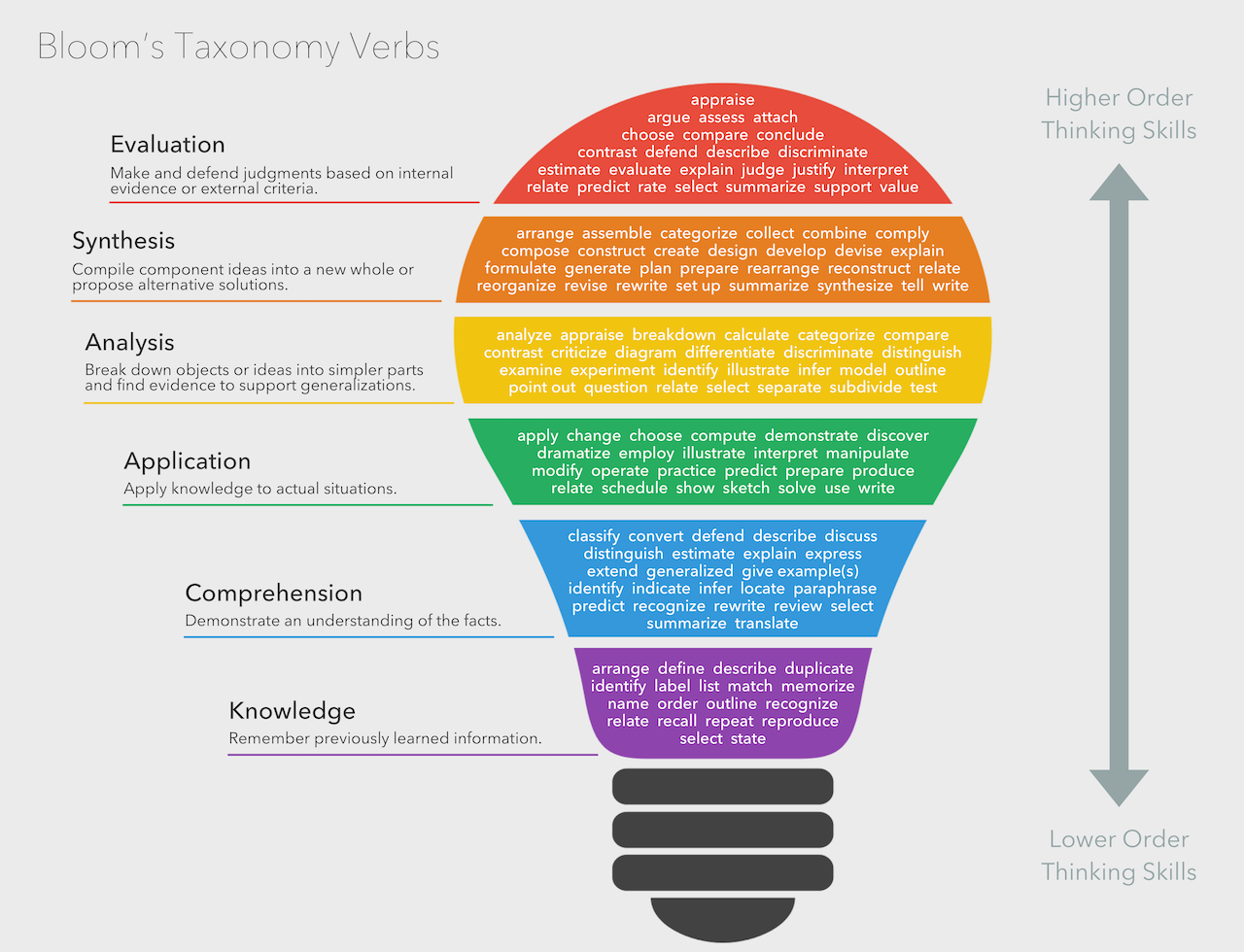
Source: File: Blooms Taxonomy Verbs.png, Wikimedia Commons. Creator: Fractus Learning.
Rights: CC BY-SA 4.0. Used under license (not fair use).
Modification: No substantive modification; resized by the publication renderer.
- Remember Recall basic information such as definitions, formulas, and core concepts.
- Understand Explain ideas, recognize examples, and restate a concept in one’s own words.
- Apply Use a concept or procedure in a concrete situation.
- Analyze Distinguish relevant features, compare alternatives, identify patterns, and investigate causes.
- Evaluate Judge the adequacy or usefulness of an approach and defend a conclusion with evidence.
- Create Integrate ideas to design a new analysis, intervention, model, or explanatory framework.
I use these levels pragmatically, not as an ironclad account of how people actually think and learn. They are shorthand for the kind of performance I expect learners to demonstrate at a particular point. Their value is that they allow me to make these goals and objectives specific, chapter by chapter.
Further, allow me to caveat that Bloom’s Taxonomy is often taken to imply a kind of hierarchy or progression that makes “observation” somehow a less demanding or less impressive cognitive achievement than synthesis or evaluation. I agree with biologist Maura Flannery that observation “is often difficult and complex, a skill that needs to be learned and a talent that is much more developed in some” than others (Flannery 2007, 561). Process improvement relies heavily upon observation, and learning to see is one of its primary challenges.
2.3 Putting It Together: The Learning Map
So, now we have five belt levels, six knowledge domains, and six broad levels of cognitive performance. All that remains is to make a matrix and begin selecting topics and bloom levels by belt. The Learning Map puts those coordinates together in a table showing what each belt teaches in each domain and what learners are expected to do with it. The detailed accounting lives in an appendix:
The map is intentionally coarse-grained. Its purpose is to show the main capability bands, not to reproduce every chapter-level Learning Objective one-for-one.
Think of the appendix document as a navigation chart rather than a checklist. If you are self-studying, use it to identify your likely next bottleneck.
Real projects are messy, and development is not always linear. You may need to pull a Black Belt-level statistical tool into a Green Belt project or revisit White Belt fundamentals halfway through a difficult initiative. That’s not failure; that’s just good applied practice.
2.4 From Learning Objectives to Practice
Understanding Bloom’s taxonomy makes it much easier to design opportunities for practice and self-assessment. Each chapter begins by identifying one or more Learning Objectives that state what the learner should be able to do with the content. Each learning objective is aligned to a specific knowledge domain and Bloom level. The exercises at the end of the chapter are then deliberately designed to test that content at the appropriate level.
At the White and Yellow Belt levels, four recurring exercise types provide much of the structure:
Recall and Explain targets Remember and Understand. The learner supplies a definition or explains a concept in their own words. These are low-stakes exercises, but they build the vocabulary needed for more complex work.
Apply to a Scenario targets Apply. The learner receives a miniature case or worked problem and uses a concept or tool. At White Belt this may be pencil-and-paper; at Yellow Belt and above it often involves Python.
Analyze and Identify targets Analyze. The learner examines a short description of a process or situation and diagnoses what is happening—classifying wastes, identifying plausible causes, spotting gaps in a process model, and so on. It is easy to define a form of waste; it is harder to recognize one in an unfamiliar context.
Reflect and Transfer asks the learner to connect the chapter’s ideas to their own experience or workplace. Depending on the prompt, this may involve application, analysis, or evaluation. Because these questions rarely have a single correct answer, answer guidance describes the features of a strong response rather than prescribing a model answer.
Short Journal and Reflect prompts appear alongside these exercises throughout the book. They capture what the learner noticed, assumed, or still finds uncertain. They are a metacognitive practice rather than a separate rung of Bloom’s taxonomy. That just means their purpose is to make us think about our own thinking. The journal preserves earlier reasoning so we can revisit it after more experience.
This pattern is consistent enough that engaged readers should recognize it quickly, but flexible enough to follow the content rather than forcing every chapter into the same mold. Not every chapter will contain every exercise type, and some will emphasize one more heavily than another. The exercises form a practice bank rather than a demand every learner complete every item. Independent learners and instructors may choose to complete a representative subset when time is limited, provided the selection still covers the chapter objectives and includes the integrative exercises that feed the belt project. For a reduced White Belt path, preserve the Wash n’ Fold case work and at least one transfer exercise in each chapter.
At the Green Belt and Black Belt levels, the cognitive demand shifts upward and the exercises increasingly require interpretation, evaluation, and design. Pencil-and-paper work gives way to substantial data work in Python, and a correct numerical answer is no longer sufficient. Three additional exercise types become prominent:
Compute and Interpret gives the learner a dataset and asks them to produce an output using
lss4pyor standard Python libraries, then explain what it means for the process under study. Getting the number is table stakes; the real work is the interpretation.Critique and Evaluate presents a completed analysis—a control chart, regression output, FMEA, process model, or similar artifact—and asks the learner to assess its quality, identify what it does and does not establish, or recommend a next step.
Design asks the learner to plan something from scratch: a sampling strategy, a measurement system, an experiment, or a DMAIC project outline. These are among the most demanding exercises in the book and appear most frequently at the Black Belt level.
At the Master Black Belt level, the center of gravity shifts toward open-ended reflection and program-level design. Exercises ask for deployment roadmaps, coaching responses to realistic project scenarios, and strategic evaluations of program-design choices. At this level there are rarely unique correct answers; there are more and less defensible ones.
If you are reading this book at modernprocessimprovement.com, then you are reading the HTML version of the book, which means exercises with a clear correct answer include a collapsed answer callout. On the other hand, if you are reading the printable PDF, those authored answers are collected in the solutions appendix instead of being repeated after each exercise. Open-ended White Belt chapter and capstone exercises include acceptance guidance about what to look for rather than one prescribed answer. These are public practice exercises, separate from the operational chapter reviews and cumulative White Belt assessment delivered through the LMS. The operational assessment questions, scoring keys, and feedback are not included in the PDF or offline package.
Some chapters also include one or two optional stretch prompts, marked with a visible [Stretch] label. These extend a concept, foreshadow a later capability, or give ambitious learners a glimpse of what becomes possible at a higher belt. They are motivational prompts, not hidden requirements for demonstrating the chapter’s expected competence.
2.5 Anatomy of a Belt and Its Chapters
The exercise patterns just described sit inside a larger instructional structure. The individual chapter is important, but the belt level is the primary unit of development in this book. Each belt forms an arc: it opens with a problem that creates a need for the new capabilities, develops those capabilities across a sequence of chapters, and closes by asking the learner to integrate them in a capstone project.
2.5.1 The Threshold Story and Belt Promise
Each belt begins with a Threshold Story. The story places the learner at the threshold of a new level of practice by presenting a grounded business problem that cannot yet be solved responsibly with the capabilities developed so far. It includes incomplete evidence, competing explanations, failed or fragile improvement attempts, and recognizable human stakes. There is no heroic leader with a magical solution. The point is to create an honest reason to learn the methods that follow.
For example, White Belt opens in Chapter 3 with a Threshold Story in which a laundromat struggles with recurring late Friday pickups. The staff are busy, different people have plausible but conflicting explanations, and a small improvement appears to work before the process drifts backward. The story does not solve the problem for the learner. It establishes the situation that the learner will gradually become capable of investigating.
The Threshold Story also serves as the belt’s instructional on-ramp. It identifies:
- The learner’s assumed starting point;
- The Belt Promise;
- The anchor case that will recur throughout the belt;
- The capabilities the belt will develop;
- Any required equipment or technical setup;
- The artifacts the learner will build; and
- The capstone in which those artifacts will be integrated.
The Belt Promise states what the instructional system should enable the learner to do in practical terms. White Belt, for example, promises that by the end of the belt the learner will be able to run one complete, evidence-based improvement cycle on a small real process and communicate the result clearly, using only pencil-and-paper tools if desired.
Learners completing a Belt level will be asked to perform an honest self-assessment about whether they feel that promise has been met. Ultimately our goal is to collect this feedback from our learners via the modernprocessimprovement.com website to help improve the book in the future. In essence, what we are trying to do with the website is to apply process improvement thinking to the process improvement curriculum itself.3
2.5.2 The Instructional Chapters
After the Threshold Story, the belt proceeds through a sequence of instructional chapters. The anchor case introduced in the story runs through those chapters, allowing the learner to return to the same process with progressively more capable eyes. Each chapter contributes concepts, methods, and usually an artifact that will be needed later in the capstone. Non-anchor examples and transfer exercises keep the learner from merely memorizing the details of one case.
Although the subject matter varies, instructional chapters have a recognizable shape:
- Why This Chapter Matters establishes the practical problem and explains why the chapter belongs at this point in the belt.
- Learning Objectives state what the learner should be able to do, identify the relevant knowledge domain, and specify the expected level of cognitive performance.
- Concepts, examples, and worked applications introduce the material in context and expose how it is used.
- The anchor-case thread connects the chapter to the belt’s continuing problem and to an artifact needed for the capstone.
- Exercises provide objective-aligned practice using the anchor case, additional examples, and unfamiliar situations requiring transfer.
- Answer guidance provides feedback appropriate to the exercise. HTML places authored answers in collapsed callouts; the printable PDF collects those same answers in a solutions appendix.
- Reflection prompts ask the learner to examine assumptions, uncertainty, and connections to their own experience.
- The Chapter Summary restates the durable ideas and makes the transition to the next part of the belt visible.
Not every chapter gives these elements equal weight. A conceptual chapter may emphasize definitions, distinctions, and reflection; a computational chapter may emphasize worked code examples and interpretation; a project chapter may require the learner to produce and defend an artifact. But the shared structure provides orientation and accountability without forcing unlike subjects into identical containers.
2.5.3 Artifacts and the Capstone
The chapters are designed to accumulate work rather than produce a series of disconnected quiz scores. In White Belt, for example, the learner works through the Wash n’ Fold problem definition, observation record, Mapping Worksheet Set, current-state SPPM, Baseline Performance Readout, waste diagnosis, countermeasure design, before-and-after comparison, and Act recommendation as the case unfolds. Those completed artifacts provide a worked model for the capstone. The learner then constructs the same chain of evidence for a small daily process at home: what was happening, what evidence was collected, what changed, what did not, and what should happen next.
The capstone is therefore the principal integration point for the Belt Promise. It does not prove a learner will succeed in every future project, but it requires more than recalling terminology or applying one isolated tool. It asks whether the learner can coordinate the capabilities developed across the belt and use them to produce a defensible piece of improvement work.
2.6 How to Use This Book
If you are studying independently and have no prior Lean Six Sigma background, begin with White Belt and proceed in order. If you have previous training or experience, do not assume the color printed on a certificate identifies the best entry point. Use the learning map and chapter objectives to locate the earliest capability you cannot yet demonstrate confidently, then begin there. Moving backward to rebuild a missing foundation is not regression; it is efficient learning.
Once you have chosen a belt, begin with its Threshold Story. Read the Belt Promise carefully, note the artifacts you will be expected to produce, and keep the opening problem in mind as you work through the instructional chapters. The chapters are sequenced deliberately, and later chapters may assume you have completed the exercises and artifacts introduced earlier.
Do the exercises before consulting the answer guidance. In the online version, open a collapsed answer callout after making your attempt. In the printable PDF, consult the solutions appendix. Use those materials to examine your reasoning, not merely to determine whether your final answer matches. For open-ended questions, compare your response with the stated criteria for a strong answer and note what you overlooked or would change.
Keep your journal entries and chapter artifacts together as you progress. The journal gives you a record of how your judgment develops; the artifacts become inputs to the belt capstone. When you reach the capstone, complete it before deciding whether you have fulfilled the Belt Promise. Use any gaps you discover to identify what to revisit and what your next useful stretch should be.
2.7 Conclusion
You now have the full floor plan. The belt levels tell you how far to go; the knowledge domains tell you what the work covers; cognitive levels make the expected performance explicit; the learning map shows how those dimensions intersect; and the exercise structure turns the architecture into practice.
None of this needs to be memorized. Return to this chapter when you need a compass bearing, and treat the learning map as a working reference you can consult as you progress.
Enough pedagogy; let’s build something.
The American Society for Quality already publishes a Code of Ethics.↩︎
Note that our White Belt requires considerably more time and effort than other curricula, which treat it as essentially a one-hour overview of the content to be learned in Yellow Belt.↩︎
Once I hoped this idea of applying process improvement tools and techniques to improve the process improvement curriculum might be a genuinely original idea. Fortunately, it is not so. (Bryk et al. 2015) presents recognizable process improvement concepts as part of an extended argument about how to improve the quality of the U.S. educational system generally, and explicitly credits the idea to process improvement thinking encountered in a healthcare context. May their tribe increase!↩︎