4 Lean Foundations
“A dissatisfied customer does not complain; he just switches.” — Oliver Beckwith, quoted by W. Edwards Deming
4.1 Why This Chapter Matters
Success in business depends on many factors, including some nobody can control. Effort, talent, and a sound business plan are all vital components. But organizations also need processes capable of producing the quality their customers expect. An organization can fail despite serious effort when it misunderstands what its customers value or how their processes create that value.
This chapter introduces four key concepts—firm, customer, value, and process—and two guiding principles that ground improvement work: continuous improvement and respect for people. Together these six ideas provide a foundation for the improvement work that follows. Without that foundation, later tools can become rituals rather than the means of improving performance.
The next chapter turns this vocabulary and philosophy into actionable guidance.
4.2 Learning Objectives
By the end of this chapter, the student will be able to:
- Business Understanding Define “firm,” “customer,” “value,” and “process,” and explain how they are related Bloom:Understand
- Data Understanding Explain what a process run is and why multiple runs matter for observing and improving a process Bloom:Understand
- Data Understanding Define a process variant and explain why documenting variants matters during process observation Bloom:Understand
- Lean Six Sigma Principles and Tools Describe continuous improvement and respect for people as mutually reinforcing foundations of Lean practice, and explain why neither is sufficient without the other Bloom:Understand
- Lean Six Sigma Principles and Tools Recognize practices that support—or undermine—continuous improvement and respect for people in an organization Bloom:Understand
4.3 Foundational Concepts
Let’s begin with four interrelated concepts: the firm, the customer, value, and process. These concepts are absolutely crucial to everything we will do later. Think of this section as a primer on the language of process improvement.
4.3.1 The Firm
Definition 4.1
Note how broad this definition is. A solo lawyer, a local coffee shop, and a global auto manufacturer are all firms in this sense: each exists to deliver value to someone. Firms differ widely in scale and industry. One thing they all have in common, however, is that they all have customers. Depending on the industry, customers may also be called clients, patients, students, patrons, members, or users.2
So let’s get clearer on what a customer is.
4.3.2 The Customer
Definition 4.2
The customer of a firm is the person or organization that receives the benefit of its services or the use of its goods, regardless of who pays. The customer, payer, purchaser, and funder may be the same party, but they need not be.
The customer should be distinguished from other kinds of stakeholders, such as employees, shareholders, suppliers, regulators, and community members. A stakeholder is someone affected by the firm and its operations. All customers are stakeholders, but not all stakeholders are customers. The customer is a special stakeholder because the customer receives the benefit of the goods or services the firm provides. In many commercial settings, the customer also pays directly. In healthcare, education, insurance, government, and family purchases, another party may pay or authorize funding. Keeping the recipient and funder distinct prevents the source of payment from silently replacing the needs of the person or organization the process exists to serve.
You will also sometimes see people distinguish internal and external customers. Large firms are often divided into functions—finance, HR, operations, sales, and engineering—that serve one another. In this way of speaking, the downstream business function consuming the upstream business function’s output is an internal customer of the upstream unit. I find this terminology somewhat misleading. Fulfilling a request from an internal customer does not directly create value for the people the organization exists to serve and no external party is willing to pay the firm for fulfilling that internal request itself. To put the point bluntly: if nobody is buying what we’re making, we don’t need to hire employees, file taxes, or organize a training retreat, as important as those activities may be.
Of course, firms still need their internal functions to work together efficiently and effectively, and process improvement projects often do focus their efforts on those internal functions. In that setting, it can be useful to treat the downstream recipient of an internal service as if it were a customer. To keep that “as if” qualification visible, this book refers to such recipients as internal customers. Unless otherwise qualified, customer means the external recipient of the benefit or use of the firm’s goods or services.
Who are your firm’s customers? Who is NASA’s customer, and how does that customer fund NASA?
But what is this “value” our customers want?
4.3.3 Value
Definition 4.3
The value of a product or service is its worth to the customer, judged from the customer’s point of view.
When I order a pizza, I value an enjoyable meal. When I hire a financial advisor, I value credible guidance toward my financial goals. When I buy a car, I value safe, reliable transportation. When I join a gym, I value convenient access to a suitable place to exercise.
One of the central challenges in process improvement is maintaining a clear view of what customers value. Changes made without that understanding can reduce the benefit customers seek. If that happens, customers may leave and the business may fail.
Let me close the discussion of value with an important clarification: value is not the same as price. Price is the amount the seller charges; value is the customer’s judgment of the benefits received. In a commercial setting, a purchase is attractive when the customer expects those benefits to justify the price and other costs, such as time, effort, and risk. Because those judgments differ among customers and change over time, price is just one piece of evidence about value, not an objective measure of it.
Customers who consistently receive good value are more likely to continue funding the firm and recommend it to others. Customers who do not may withdraw their support or look elsewhere when alternatives exist.
Now let’s tease out a corollary from that definition of value.
The customer is the one who defines value, not the firm.
Firms cannot declare their output valuable by fiat. Customers judge value through their needs, choices, and experience, whether their payment is direct, indirect, or collective.
Why is the business portrayed in this comic struggling?
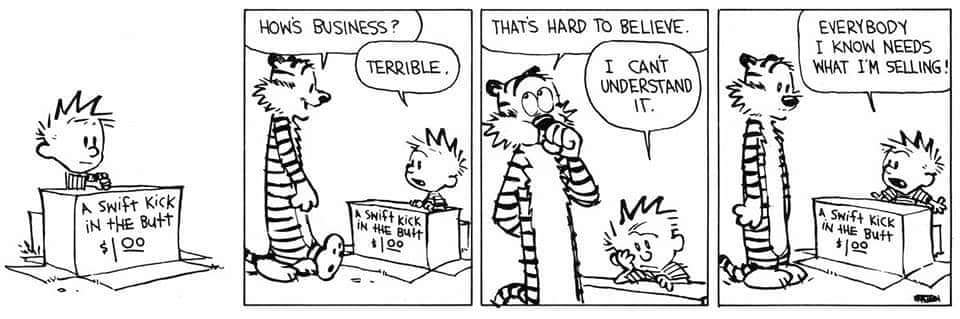
Source: Calvin and Hobbes, July 31, 1992, originally published by Universal Press Syndicate. Creator: Bill Watterson.
Rights: Used under fair use for educational commentary and analysis.
Modification: No substantive modification; resized by the publication renderer.
The business is trying to specify value from the point of view of the owner, not the customer.
The example in the comic is exaggerated, but losing sight of how the customer defines value is a common problem.
We need one more foundational concept to link the other three concepts together. Consider how an ordinary firm delivers what its customer wants.
Choose a firm you know—a café, repair shop, or delivery service, for example. List the steps by which it delivers one product or service to a customer.
For a café, the steps might include taking an order, preparing the drink, and handing it to the customer. Your sequence will depend on the firm and the product or service you chose. We call such a sequence a process.
4.3.4 Process
Let’s now give a definition of a business process.
Definition 4.4
A business process is a set of steps designed to produce a specific product or provide a specific service to a customer.
Our definition above is specifically about business processes, as opposed to chemical, geological, biological, or some other kind of process. However, for brevity, we will usually just say “process” unless the broader context makes it necessary to clarify.
For example, if the firm manufactures tires, it provides value to its customers by performing a process whose output is a tire that meets the customer’s specifications.
While we’re at it, let’s also define a process step.
Definition 4.5
A process step is a discrete unit of work.
Process steps may involve different people, tools, and information. A process can cross organizational boundaries or return to the customer for action. For example, hiring may begin with a manager’s request, move through HR, and return to the hiring manager for interviews and selection. One process can also feed another; hiring feeds employee onboarding, for example.
The point is that a process is built from discrete steps that can be observed and improved.
4.4 Process Runs and Process Variants
While we’re talking about processes, let’s introduce two more concepts: a process run and a process variant.
Definition 4.6
A process run is one complete instance of a process, traced for one thing from the process’s defined start event to its defined stop event. That thing might be one customer order, one patient visit, one service request, one batch of work, or one invoice.
For example, if you’re analyzing a customer service process, one process run would be:
- customer calls (start)
- agent answers
- agent resolves the issue
- call ends (stop)
That single journey is one run. If you watch five different customer calls on a Monday morning, you have seen five runs. Process runs become important when we begin observing a process. A single run cannot show whether what we saw was typical. Because any one run may be unusual, we usually observe multiple runs and compare their paths, timing, and outcomes.
The second concept we need here is the process variant.
Definition 4.7
A process variant is a recurring alternative path within the same process boundary. Variants share the same start event, stop event, and primary unit of analysis but differ in one or more steps, roles, timings, or decision paths.
Some variants are intentional. Different products, customer needs, or service levels may require different standardized paths. Think of a car going down the assembly line: some times we want to produce the base model, sometimes we want to produce a higher trim level that has fancier seats, or a better radio, or some pricey doodad. Producing a higher trim level vehicle might be a legitimate process variant that requires slightly different work than the base model. More commonly, however, process variants can often reveal inconsistent work, unnecessary exceptions, rework, or departures from the intended process.
The goal is not to eliminate every variant merely because it differs from the primary path. The goal is to distinguish necessary, standardized variants from unintended or wasteful ones, improve each necessary path, and remove avoidable variation.
Now that we’ve got a clear understanding of the definitions of the key concepts of process improvement, let’s turn now to the philosophical foundations to complete this stage-setting chapter.
4.5 Two Pillars
The Toyota Way is a distillation of the organizational principles that have led the Toyota Motor Corporation to become the largest automobile manufacturer in the world.3 The Toyota Way explicitly names two principles “pillars” of its approach to business: continuous improvement and respect for people. In this book, we use them as philosophical and ethical foundations for Lean practice. Neither works well alone. Improvement without respect can become exploitation, while respect without disciplined improvement leaves preventable problems in place, frustrating customers, staff, and management alike.
4.5.1 Respect for People
Respect for people isn’t just about being polite. Respect for people means recognizing them as agents with knowledge, dignity and the same rights we want for ourselves. Of course, we cannot have respect for people in a work environment characterized by prejudice or discrimination. But meeting the bare requirements of labor law is not yet to begin the deeper work of building a culture of respect.
- We respect customers when we view them as people who have the right to make their own, informed decisions and provide them with honest information; we don’t try to dupe them with deceptive advertising.
- We respect staff when we treat them as individual co-workers with valuable experience and insight that we may lack; we don’t practice “mushroom management”.4
- We respect ourselves by advocating strongly for our conclusions, to the degree the data warrants; we don’t cave just because somebody in senior leadership doesn’t like what we have to say.
- We respect other stakeholders—members of the local community who can be affected by traffic, pollution, noise, or demands upon local infrastructure—when we account for those effects in our decisions.
If we fail to respect any of these groups, we risk losing the knowledge and cooperation our process improvement efforts depend on. Allow me to illustrate very simply. Suppose we run a project where we extract valuable knowledge from our front-line workers and devise a simpler, more efficient process. Then, after implementing the improved process, we lay off everybody who helped us build it. Management gets bonuses; the staff gets screwed.
And then what happens on the next project? Management announces a new process improvement initiative. Consultants fly in. The staff has good reason to withhold what it knows. The next project may still extract a gain, but management has made cooperation harder and left itself less able to learn from the work. Lather, rinse, repeat; forever and ever, amen.
In real process improvement, we value people as individuals with valuable accumulated knowledge—because that’s what they are.
So, what do you do if your management wants you to run a “process improvement” project built around treating their staff like garbage?
Don’t. Refuse to help them disguise exploitation as “process improvement.”
4.5.2 Continuous Improvement and Ethical Competition
The other pillar of process improvement is continuous improvement. We’ve already seen one dimension of the philosophy of continuous improvement. We are always seeking to make our processes better. But there is also a deeper, ethical dimension of continuous improvement as well. The philosophy of continuous improvement tells firms to compete in the marketplace by becoming better at creating value.5
Let’s illustrate the importance of this admonition by considering its alternative. Business competition can reward excellence, but high stakes also tempt firms to seek those rewards through deception, coercion, manipulation, or the transfer of costs to people who did not consent to bear them.
For example:
- Concealing known defects or safety risks from customers, workers, or regulators
- Designing products to fail prematurely or making repair unnecessarily difficult
- Using deceptive pricing, hidden fees, subscriptions, or “dark patterns” to undermine informed customer choice
- Exploiting customers’ personal data in ways they did not meaningfully understand or consent to
- Manipulating performance measures, financial statements, or quality records to create the appearance of success
- Pressuring employees to work off the clock, falsify records, skip safety procedures, or conceal problems
- Retaliating against employees who report defects, hazards, fraud, or mistreatment
- Treating layoffs, chronic understaffing, and work intensification as the primary means of improving “productivity”
- Transferring unreasonable risks and costs to suppliers while demanding unsustainable prices or delivery schedules
- Deliberately creating dependence on a proprietary platform and then exploiting customers or suppliers once switching becomes costly
- Copying competitors’ work through theft, espionage, or deliberate infringement rather than developing better capabilities
- Using market power to suppress wages, dictate unfair supplier terms, or acquire competitors merely to eliminate them
- Privatizing gains while shifting the costs of pollution, illness, infrastructure, or financial failure onto the public
- Meeting the letter of a law while deliberately defeating its purpose through regulatory or tax arbitrage
If your “business strategy” relies on any of the above, process improvement cannot make it ethical. That strategy needs to change; I will not help dress it up as improvement.
Continuous improvement offers a different path: we compete by understanding our customers and what they value, innovating to create better offerings, and improving how work is done. Increased efficiency and quality can create room to lower prices, invest in people, and withstand setbacks. Training and retaining a skilled workforce builds capacity for further innovation and improvement.
Incentives matter. A firm that rewards short-term results gets short-term behavior: deferred maintenance, concealed defects, excessive risks, mistreating customers, and the unethical behaviors cataloged above. But each shortcut undermines the business, subtly or not so subtly.
And of course, eventually the business cycle goes bust. When cash is tight and credit expensive, expect your customers to examine the value your firm offers much more critically. If you’ve built your business on the bedrock of delivering superior value, you can welcome their scrutiny. If you haven’t—well, it’s always a good idea to keep your résumé up-to-date.
Nothing guarantees success in business; sometimes sheer bad luck can wreck a firm, no matter how well-managed. Even so, I commend to you the philosophy of process improvement described in this chapter. It is not only prudent management; it’s also the right thing to do.
These two pillars will only show up occasionally as explicit discussion topics below. However, they are almost always present in the background.
The Wash n’ Fold case gives these foundations a concrete thread through the rest of White Belt: the laundromat is the firm, the person receiving the clean laundry is the customer, and the observed sequence of work is the process by which that value is created. In the White Belt capstone, these distinctions become the basis for deciding whether a proposed change improves the customer’s experience without treating the people doing the work as expendable inputs.
4.6 Conclusion
When we improve a process, we are improving the mechanism by which the firm creates value for its customers. This is why process improvement is so crucial. Better processes can improve service and free resources for investment in the business and its people. Whether that happens depends on the costs of the change, market conditions, and what the firm chooses to do with the gains.
4.7 Exercises
1. Bloom:Understand In your own words, explain how the four foundational concepts — firm, customer, value, and process — are related. Your answer should be a short paragraph that could serve as an explanation to a colleague who has never studied process improvement.
A firm is an organized entity whose reason for existing is to provide value to its customers. The customer is the person or organization that receives the benefit of the firm’s services or the use of its goods, whether that customer or another party pays. Value is the worth those goods or services have from the customer’s point of view. The mechanism by which the firm actually delivers that value is a process: a repeatable set of steps that transforms inputs into a product or service. Improve the process, and you improve the firm’s ability to create value for the customer.
2. Bloom:Understand Using the Wash n’ Fold case, identify the firm, the customer, the core value the customer receives, and the process being improved. Write your answer in 3–4 sentences.
The firm is the Wash n’ Fold business. The customer is the person who receives the clean, folded laundry and the benefit of reliable return, regardless of who pays. The core value is clean, correctly handled laundry returned when promised. The process being improved begins when the customer drops off an order and ends when the completed order is staged and the customer is notified that it is ready.
3. Bloom:Understand In your own words, define a process run and explain why observing multiple runs is better than observing only one.
A process run is one complete instance of the process moving from its start event to its stop event for one thing being followed. Observing multiple runs is better because one run may be unusual, while repeated runs let you see typical timing, variation, and recurring trouble spots.
4. Bloom:Understand Think about a process you participate in regularly — at work, at school, or in daily life. In one or two sentences, describe the process and identify who the customer is. Then: does the firm or organization running that process seem to understand what you, as the customer, actually value? Give one piece of evidence for your view.
Answers will vary. Look for (1) a clearly named process with a plausible customer identified, (2) a specific value claim—not just “good service,” but something concrete the customer cares about—and (3) observable evidence rather than opinion alone. A strong answer may find alignment or tension between the firm’s priorities and customer value, but its conclusion should follow from the evidence given.
5. Bloom:Understand In plain language, explain what process variants are and why we care about them for process improvement work.
Process variants are recurring alternative paths through the same process boundary. We document them so that we can distinguish necessary paths from inconsistent work, exceptions, and rework instead of treating every difference as either harmless or defective.
6. Bloom:Understand Why can a process look busy internally while still underperforming for customers? Answer using value and process concepts from this chapter.
Visible activity does not guarantee that the process is producing the outcome the customer values. People may be working hard on queues, rework, handoffs, or internal requirements while the customer still waits for the promised product or service.
7. Bloom:Understand Write a two-sentence explanation of why process thinking is a prerequisite for meaningful improvement work.
Process thinking connects an outcome to the sequence of work that produces it. Without that connection, a team cannot locate delays, compare variants, or test whether a change improved the mechanism responsible for the result.
8. Bloom:Understand Explain why continuous improvement and respect for people must operate together. Give one example of an improvement practice that supports both foundations.
Continuous improvement without respect can turn efficiency into coercion or exploitation; respect without improvement can leave preventable burdens and failures in place. For example, asking the people who perform the work to identify recurring obstacles, testing one of their proposed changes, and reviewing the result with them uses their knowledge while improving the process.
4.7.1 Reflection Questions
Write 3–4 sentences about one place where your organization optimizes internal convenience at the expense of customer value, and how you would recognize that pattern earlier next time.
Write three paragraphs about a time when you were asked to do something you didn’t agree with at work. In the first paragraph describe the situation, what you were asked to do, and why you didn’t agree with it. In the second, describe the actions you took and the result. In the final paragraph reflect on what you might have done differently.
4.8 Chapter Summary
- Firms create value for customers through processes made of observable steps.
- The customer is the recipient of the benefit of the firm’s services or the use of its goods, regardless of who pays; internal recipients can be treated “as if” they were customers when practical.
- Value is judged from that customer’s point of view
- A process run is one complete instance traced from a defined start to a defined stop.
- Process variants may be necessary or wasteful; improvement requires distinguishing intentional paths from unintended ones.
- The Toyota Way pairs continuous improvement with respect for people so that better performance does not come through exploitation.
This book uses firm as an analytical term drawn from economics and organization theory for an organized unit that coordinates resources to produce goods or services. The usage is broader than ordinary commercial speech: when the same organizational questions arise in a public or nonprofit body, the book treats that body as a firm for purposes of analysis.↩︎
These labels identify the recipient of the benefit, not necessarily the funding party. A student, patient, or user may receive a service that a family, employer, insurer, or government pays for. When the recipient and funding party differ, this book reserves customer for the party receiving the benefit or use of the firm’s goods or services.↩︎
The Toyota Way is also the subject of an excellent book of the same name by Jeffrey Liker.↩︎
“Feed ’em bullshit and keep ’em in the dark.”↩︎
Liker describes Toyota as welcoming competition because it drives continuous improvement and produces better products for customers (Liker 2021, 47). I take this to imply an ethical claim about how firms should compete: by becoming better at creating value, rather than through deception, coercion, or shifting costs onto others. Likewise, Hennig and Romar (2023, 347) interprets the two pillars as explicitly ethical commitments aligned with a humanistic style of management.↩︎