11 Designing the Improved Workplace: Flow, Pull, and 5S
“Without standards, there can be no improvement.” — Taiichi Ohno
“We are what we repeatedly do. Excellence, then, is not an act, but a habit.” — Will Durant
11.1 Why This Chapter Matters
Waste diagnosis gives us a target, but it does not tell an operator what to do differently on Monday. An intervention needs an operating rule: how work moves, what authorizes it to start, where needed materials belong, and what happens when the method breaks down. This chapter develops a small, testable design using flow, pull, and 5S. Together, they turn a plausible improvement idea into work that people can actually perform and evaluate. Flow and pull address how work moves and when it begins; 5S addresses the arrangement and upkeep of the workplace.
11.2 Learning Objectives
By the end of this chapter, the student will be able to:
- Lean Six Sigma Principles and Tools Use the chapter’s design sequence to draft a bounded flow-and-pull rule tied to observed demand, capacity, and waste Bloom:Apply
- Lean Six Sigma Principles and Tools Apply the 5S elements, including Safety, and document the best current method in a one-page work standard Bloom:Apply
- Leading and Managing Projects Draft sustainment ownership, review cadence, and escalation criteria, including when 5S is insufficient to resolve a release or capacity problem Bloom:Apply
In the previous chapter, we cataloged the Eight Wastes: the recurring patterns of non-value-added activity that drag down process performance. Identifying waste tells us what to target. Now we have to choose an intervention that addresses the supported mechanism without claiming more than our evidence warrants. Flow and pull define the movement and release of work. 5S supplies the physical and digital conditions that help people follow that method and notice when reality departs from it.
11.3 Wash n’ Fold Project: Do (Continued)
We can now test whether placing detergent and softener at each Wash position reduces fetching and handoffs during setup. The shared supply jug gives us a concrete setup task to improve, but moving a jug will not abolish a 501.7-minute release wait. That distinction matters: 5S can support a better release method without being the main reason it works.
11.4 From Waste Diagnosis to Flow and Pull
Return to the current-state map and follow one order from Sort and tag toward Wash. The order is ready, but the release rule holds it until the active batch clears drying. That observation gives us two competing explanations for the queue: perhaps the shop lacks enough capacity, or perhaps usable capacity sits idle because the rule withholds ready work. The intervention depends on which explanation the evidence supports.
Before changing the release rule, ask what would happen if the next ready order entered Wash sooner. Would a worker, washer, dryer, folding station, safe staging area, or required piece of information prevent it from advancing? This traces the obstruction through the actual work instead of assuming that smaller batches must improve every process.
Where travel matters, sketch the physical route and consider moving sequential work closer together without compromising safety or access. Yellow Belt will introduce spaghetti maps, which trace actual movement on a layout so repeated trips become visible. For now, a simple route sketch and trip count are enough to support a question about layout; the process map alone does not establish the distance traveled.
11.4.1 Align Capacity with Takt, Not Every Duration with Every Other Duration
Suppose a three-person service team has 480 available minutes and demand for 40 cases. Takt is \(480/40 = 12\) minutes per case: the required average completion pace. One person performs each of three sequential steps, whose mean work times are 6, 14, and 8 minutes. The 14-minute step cannot sustain one case every 12 minutes under those assumptions, even if its worker stays busy all day.
First look for unnecessary work and feasible redistribution, not an instruction to hurry. If a trained colleague can take three minutes of transferable preparation from the middle step into the last step without changing the required sequence or quality, the loads become 6, 11, and 11 minutes. Each is now below Takt in this simplified comparison. They need not be identical, and measured variability, breaks, setup, and other duties can still prevent the team from achieving the intended pace.
An operator balance chart plots the work assigned to each operator against Takt. Bars above the Takt line identify assignments that cannot sustain the required pace under the stated assumptions.
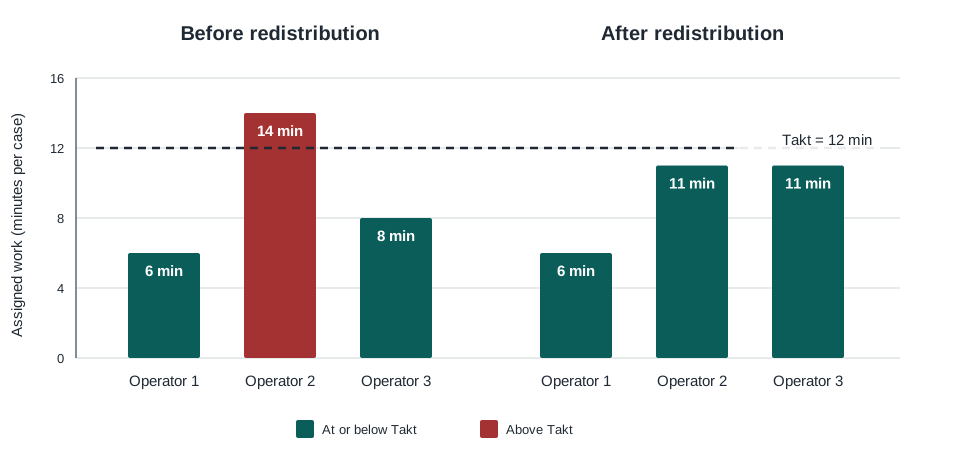
Read Figure 11.1 from left to right. Which assignment prevents the original design from meeting Takt, and what changes after redistribution? The first chart shows Operator 2 above Takt at 14 minutes. The second shows that moving three minutes of eligible work brings Operators 2 and 3 to 11 minutes each, below Takt, while Operator 1 remains at 6 minutes.
For machines operating in parallel, compare effective output capacity with demand rather than comparing one machine’s elapsed cycle directly with Takt. Two independent positions with 24-minute cycles have an ideal combined capacity of one completed unit per 12 minutes, even though each unit spends 24 minutes processing. Loading, downtime, incompatible work, or shared labor can make actual capacity lower. Do not sum automatic machine-running time and call it occupied worker time.
At Wash n’ Fold, use the two-worker, six-washer, six-dryer capacity estimates from Chapter 9 and the 18.2-minute planning Takt. The first problem to investigate is the restrictive release rule, not how to make a wash cycle, a dry cycle, and folding all take 18.2 minutes. If average capacity really is insufficient, a WIP limit cannot manufacture the missing hours. In those cases, we must change the work, rebalance feasible tasks, revise staffing or equipment, or renegotiate the service commitment.
11.4.2 Establish Pull: Specify Permission to Start
A board with colored cards is not a pull system unless the cards govern what may begin. To see what the board must accomplish, begin with the decision an operator faces: May I release another order?
Figure 11.2 offers a small teaching example rather than a recommended limit for the shop. Its controlled boundary begins when an order is released to Wash and ends when the order is ready for pickup. Three orders occupy a four-order limit. The empty position therefore answers the release question: one more ready order may enter.
Which order should enter? Order A is the oldest eligible order in the visible backlog, so a first-in, first-out (FIFO) rule selects it unless a stated exception applies. Order F is blocked by a missing label, but the customer order has not vanished. Its card remains visible and continues to occupy one of the four positions.
What returns permission to release another order? An arrival does not. An order reaching ready for pickup leaves the controlled boundary and returns one opening. If all four positions are occupied, the next ready order waits in the visible backlog until that happens.
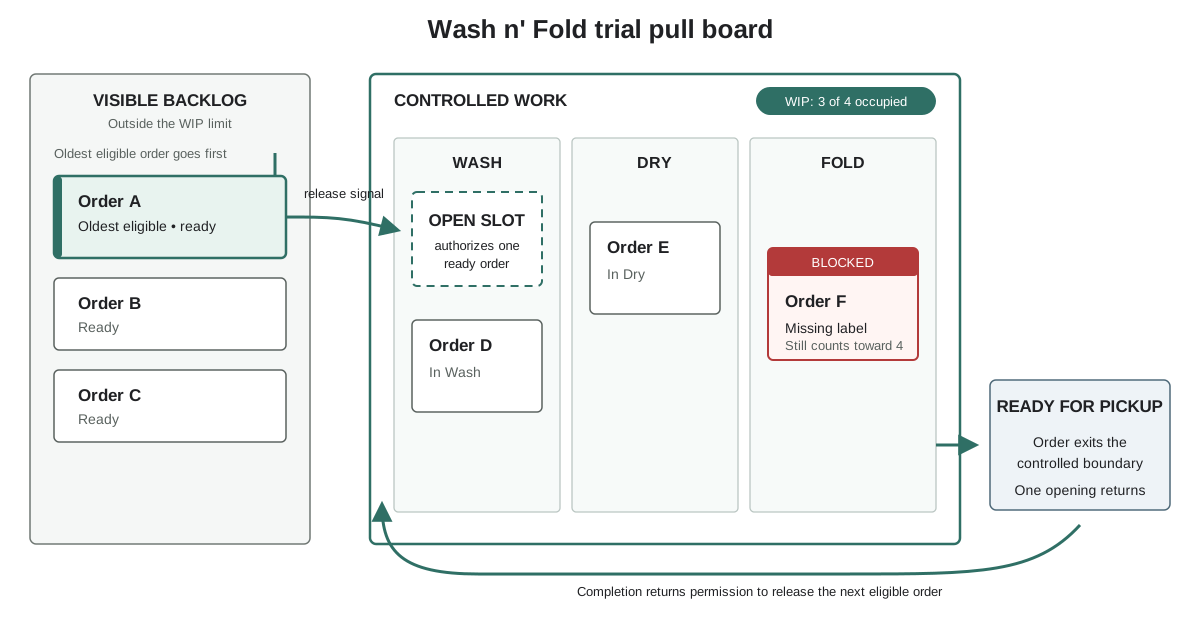
The case has now supplied the parts of a pull rule:
- Controlled work: the unit and the entry and exit events covered by the limit.
- Trial WIP limit: a starting ceiling justified by observed concurrent work, available resources, safe space, necessary buffers, and completion history.
- Visible release signal: the opening, card, bin, or digital signal that authorizes a stated quantity of work to enter.
- Selection and exceptions: the rule for choosing the next eligible item, including justified priorities and the treatment of blocked or rework items.
- Signal-return event: the specific completion that returns permission to release more work.
- Owner and review plan: who maintains the rule, what the trial will measure, and what would require adjustment.
A headcount alone does not establish a WIP limit, and a hard ceiling is not the average WIP used in Little’s Law. A limit that is too low can leave useful capacity idle; one that is too high can permit unnecessary queues.
Cards, empty bins, and digital boards are alternative ways of carrying a signal. The essential feature is explicit authorization tied to need and available capacity; Kanban Tool’s guide to pull systems illustrates these signal types. Our later comparison will test one particular rule, not the only possible pull design.
Write a short proposal containing the controlled boundary, trial limit and its reason, release signal, signal-return event, selection rule, owner, and follow-up measures. Keep unreleased work visible, and judge the whole customer journey rather than celebrating an empty production area with a growing backlog outside it.
11.4.3 Visual Controls Carry Operational Information
The pull rule has to survive contact with a busy workday. If operators must remember how many orders are authorized, search for blocked work, or ask a supervisor which order is next, the rule exists mostly on paper. A useful visual control answers an operating question at the place and moment where the decision occurs.
A card can show that one slot is available. A marked waiting lane can show which orders are authorized and which remain in backlog. A board can make the oldest ready order, the current WIP count, and a blocked item visible without a meeting. Labels at the Wash positions can show what belongs there and what needs replenishment. Each device communicates something people need to decide or act.
Color and tidiness alone do not create control. A beautiful board nobody uses to release work is decoration. A floor outline that shows where a cart belongs but gives no response when the cart is missing merely documents drift. For each visual device, ask: What decision does this control? Who reads it? What action follows an abnormal signal? If those answers are vague, improve the rule before adding more tape, signs, or colored cards.
11.4.4 Does This Change Require a Future-State Map?
Compare the proposed method with the current-state SPPM. Orders still move through Drop-off, Sort, Wash, Dry, Fold, and Stage and notify in the same broad sequence. What changes is the rule that releases an order into production, the visibility of controlled and waiting work, and the location and handling of supplies.
A second SPPM would mostly repeat the first one and could hide those operating details inside familiar boxes. For this case, keep the current-state map as the baseline and pair it with the pull board and one-page standard work. Draw a future-state map when the proposal changes the process boundary, activity sequence, handoffs, branches, or other map-level structure enough that a reader would otherwise misunderstand the proposed flow.
11.5 The 5S Elements
The current-state simulation records a shared detergent/softener jug in the Wash setup context: supplies are fetched, measured, and passed among positions, with setup repeated for compatible loads. Across the 39 orders, mean Wash setup is 2.5 minutes. That total does not tell us how much time each individual action takes.
Suppose we propose labeled supplies at the point of use. The proposal immediately raises practical questions. Which supplies belong at each position, and which should remain shared? Where can they sit without creating an awkward reach or obstructing access? How will operators notice a leak, a missing label, or stock approaching empty? What method should everyone follow, and who will restore the arrangement when it drifts?
The 5S elements give us a disciplined way to answer those questions. They come from the Toyota Production System and are commonly translated into English as Sort, Set in Order, Shine, Standardize, and Sustain. Many teams explicitly add Safety, although safety belongs in every decision from the start. The sequence is a useful starting point rather than a one-way checklist: decide what belongs before arranging it, clean and inspect the area, agree on the best current method, and build routines that keep it workable. As the work teaches the team something new, return to an earlier decision.
The decisions below develop the point-of-use supply proposal; they are not a report of changes implemented in a real shop.
| Proposed change | Local check | Customer-outcome check |
|---|---|---|
| Put needed supplies within reach | Retrieval and setup time; dosing errors and handling problems | End-to-end lead time and eligible-order promise violations |
| Keep supplies available and correctly placed | Missing supplies, replenishment interruptions, and misplaced items | Whether any local gains also improve promise performance |
11.5.1 Sort
Putting every available product beside every washer would eliminate some fetching and create a new stock problem. Containers would occupy space, expire, leak, and require replenishment whether that position regularly needed them or not. Sort asks what the work actually requires: keep needed tools, materials, and information available, and review what does not belong.
One commonly used technique to achieve this is called Red Tagging. The idea here is that we place a colored tag, sticker, or some other visual cue on all of the tools and materials in the workspace. Every time someone uses a tool or material, they remove the sticker. After a defined observation period, review items that still have a tag with the people responsible for the work. An unused item is a candidate for review, not automatic disposal: occasional tasks, emergencies, and required equipment may not have appeared during that window. Decide what must remain accessible, what can move to longer-term storage, and what can be discarded.
For homely examples, think of your kitchen cabinets. A good cabinet organization scheme should have all the materials you use daily like plates, cups, and silverware easily accessible, with less frequently used items like the Bundt cake pan or cookie cutters stored somewhere less convenient.
In a transactional environment, when you find yourself going to an internal shared hard drive or combing through a SharePoint library full of outdated materials, this is a sure sign that you’re experiencing the waste of motion and would benefit from a “Sort” on your work materials.
For our supply proposal, ask the operators what each Wash position needs for its usual work and its exceptions. Determine which supplies belong at each position and which should remain shared. Duplicating everything would replace a retrieval problem with excess stock and more containers to maintain.
11.5.2 Set in Order
Knowing what belongs does not tell us where to put it. A detergent container can be present and still require repeated walking, obstruct a path, or force an awkward reach. Set in Order gives each needed item a specific location chosen around sequence, access, visibility, and safe handling.
While it is difficult to give universally applicable, general guidelines about the right way to set up your workstation, even in manufacturing, there are a couple of principles to consider that may help your thinking.
- Try to make work areas “cellular,” meaning that each workstation in the work area produces only one product (or product family), so that you can gather all the tools needed to make that product in one place with a minimum of transportation of materials back and forth.
- Try to keep the size of the workstation small enough to encourage continuous flow rather than the production of large batches.
- Try to position all materials and tools ergonomically and within easy reach of the operators, to minimize the time they have to spend stretching or reaching.
- Consider adopting a straight-line or U-shaped layout for work areas. If the final product needs to end up back at the same physical location where the order arose, a U-shaped layout is a natural solution.
- Try to make it easy for someone to determine just by looking at the work layout where each product is in the production process.
If you follow these general guidelines, you’ll probably hit on an acceptable ordering of the workspace pretty quickly. Through experience and experimentation, this can be refined with the assistance of the operators.
If we’re working on a project in a transactional process, such as processing an invoice or generating a report, then applying these principles relates more to the motion involved in navigating between different screens in a piece of software. Setting a virtual workplace in order follows most of the same principles as setting a factory floor in order: again, we’re trying to gather like pieces of work together and make it as easy as possible for people to find the information they need quickly.
For the supplies we decide to place at each position, choose an accessible location with the operators and make the contents and intended location clear. Check that reaching for them does not obstruct access or create awkward handling. Try the arrangement through the actual setup motions before treating the layout as settled.
Operators know where the written process collides with a heavy bag, a rush of arrivals, an unreliable label, or a task that quietly requires two hands. Involve them while observing the current method, choosing the intervention, trying the arrangement, and writing the standard.
This is not merely a way to obtain better facts, although it does that. People are more likely to support and continue a method they helped test and improve than one delivered after the project team has already made the important decisions. Participation does not mean accepting every preference or avoiding difficult changes. It means treating operators as sources of operational knowledge and as partners who will have to make the method work after the project closes.
11.5.3 Shine
The proposed containers now have sensible locations, but a slow leak or damaged label could remain hidden by residue and clutter. Shine means cleaning and inspecting the work area so abnormalities become visible. In manufacturing, this means cleaning machines, floors, work surfaces, and tools so that leaks, wear, misalignment, and safety hazards become immediately visible. In service and transactional work, “shine” means maintaining the digital workspace too: reviewing stale tickets, archiving obsolete files, clearing broken links, and keeping the active queue transparent. Resolve or escalate outstanding work; close a ticket only when the work is complete or confirmed no longer required. Age alone is not a reason to make a customer request disappear.
The point is not cosmetic perfection; the point is to make the process visible. A clean workspace makes abnormalities easier to detect and respond to. For the supply arrangement, include inspection of containers and their locations so spills, leaks, or deterioration can be noticed and addressed. These are conditions to inspect for, not incidents established by the simulation.
11.5.4 Standardize
Suppose one operator returns the detergent after each load, another leaves it beside the washer, and neither knows who should refill it. The new location exists, but the method still depends on memory and private interpretation. Labels alone have not standardized the work.
Standardize records the best current method clearly enough that two trained operators would perform the important parts in the same way. The standard names the trigger, sequence, responsible role, expected condition, quality and safety checks, abnormalities, and escalation route. It creates a stable baseline from which the team can detect drift and learn; it does not make the first answer permanent.
A standard is the team’s best current method, not a commandment delivered from outside the work. The people who perform the process know where instructions become awkward, where exceptions arise, and which shortcuts signal that the written method does not fit reality. Build the first version with them, make it specific enough to use, and revise it when evidence reveals a better way.
Figure 11.3 shows one way to fit the Wash supply method on a single page at the place of work. Read it from the purpose and trigger into the five steps, then inspect the stop conditions and trial checks. Notice what the page does not do: it does not bury the operator in background theory or pretend to replace product instructions and site safety procedures.
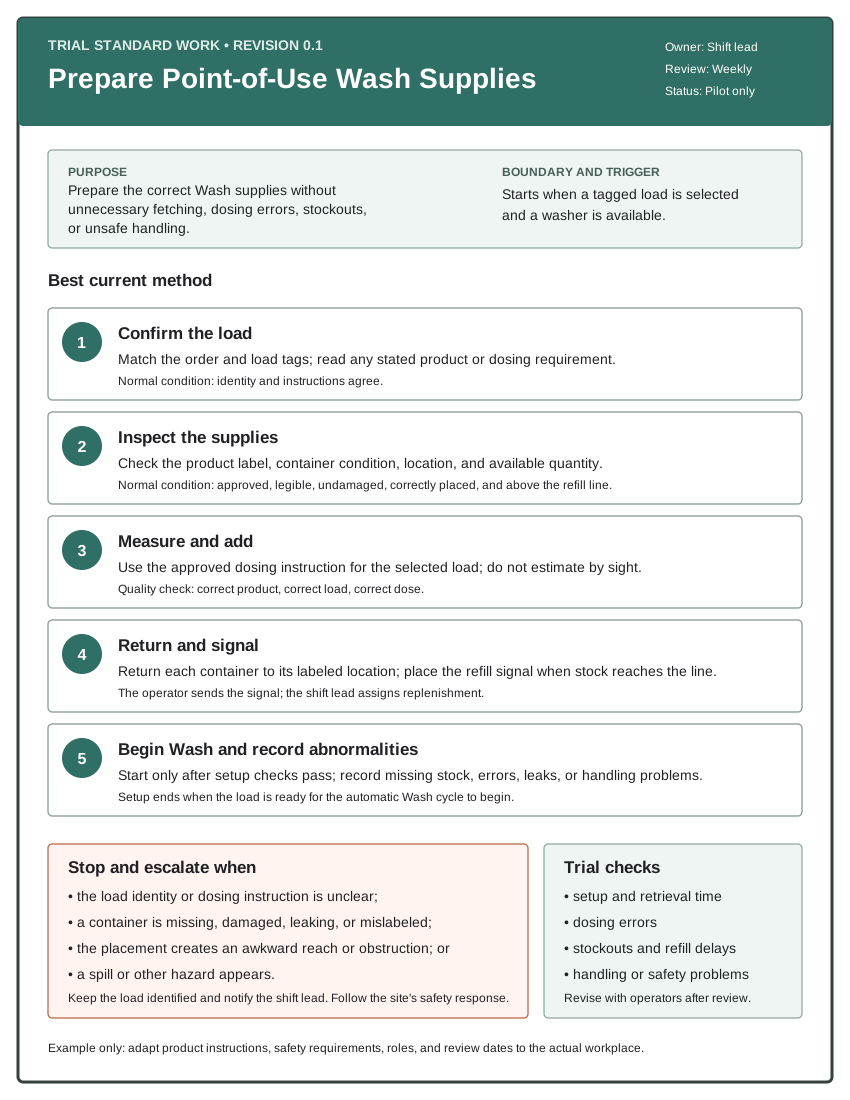
Download the completed Wash setup standard (US Letter PDF) to inspect beside your own draft.
Use Figure 11.4 when your proposal creates or changes a repeatable operating method that another person needs to perform consistently. Keep the standard to one page. Do not create one merely to complete a form: a location change or one-time removal may need an owner and check without needing procedural standard work. If a repeatable method cannot be stated that plainly, the team may not yet agree on it or may be trying to force several distinct tasks into one document.
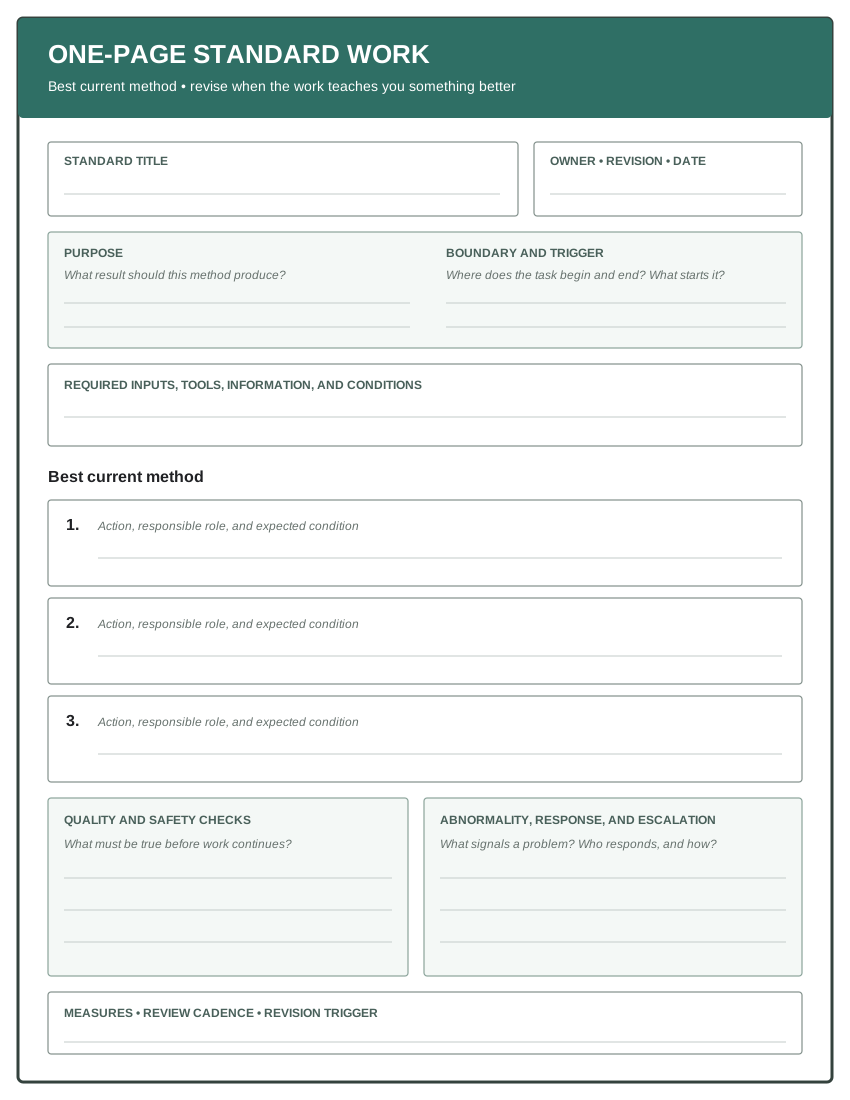
Download the blank one-page standard work template (US Letter PDF) when your proposal needs a repeatable method. Print one copy per method and fill it with your own process’s conditions; do not copy the Wash setup instructions into an unrelated process.
The pull rule needs the same precision even though its visual control is a board rather than a supply label. An open position triggers release of the oldest eligible order; a blocked order remains visible and keeps its position; persistent blocking goes to the shift owner. That detail keeps two well-intentioned operators from inventing different systems halfway through the trial.
11.5.5 Sustain
Suppose the arrangement works during the project week, then the refill cards disappear and containers begin migrating between washers. The design did not become self-maintaining when the labels were attached. Sustain creates the ownership, review, correction, and revision routines that keep the method alive after the improvement event.
To sustain gains, use simple management routines:
- A short recurring audit (daily or weekly) with a small checklist.
- A named owner for each area/process.
- Fast correction of drift when standards are not being followed.
- Periodic review to update standards when the process changes.
In other words, sustain is about behavior, not just layout. The organization has to reward disciplined adherence to standards and continuous small improvements over one-time cleanup events.
A trial sustainment routine could assign one person each shift to check availability, labels, and placement, with a weekly review of setup times and interruptions. Record missing or misplaced supplies and replenish or correct them through the agreed method. Repeated shortages should trigger a review of the replenishment rule; repeated misplacement may mean the chosen location does not fit the work. The owner needs a way to get those problems resolved, not just a checklist to initial.
That last distinction protects sustainment from becoming audit theater. A high checklist score is evidence that recorded conditions met the checklist; it is not evidence that the process improved. If setup remains slow while every box is checked, the checklist may be measuring the wrong things. If the same exception appears every week, the cause may be an unrealistic standard, insufficient replenishment capacity, or a problem the named owner lacks authority to correct. Treat recurring noncompliance as information about the design as well as behavior. Review performance beside compliance, give the owner a clear escalation path, and change the standard when the work teaches you that it should change.
A leader cannot announce 5S, inspect a score, and leave operators to supply the time, materials, authority, and persistence the method requires. Leaders need to visit the work, listen to the people doing it, remove obstacles they cannot remove themselves, and visibly follow the same standards they expect others to follow.
Toyota describes its operating philosophy as resting on Continuous Improvement and Respect for People, with success created through individual effort and teamwork (Toyota Way 2001). The Lean Enterprise Institute makes the practical consequence plain: visual management and standard work fade when leaders treat respect and engagement as optional and disappear once the implementation team leaves (“Leading with Respect Is Not a Soft Skill”). Visible participation matters because it shows that maintaining and improving the workplace is part of the work, not cleanup delegated to people with less authority.
11.5.6 Safety
Many teams explicitly include Safety as a sixth S because unsafe work is always defective work. An injury, near miss, ergonomic strain, or unmanaged hazard is both a human cost and a process failure.
In practical terms, safety should be integrated into each of the other S’s:
- Sort: remove hazardous clutter and obsolete materials.
- Set in Order: place tools/materials to reduce overreaching, twisting, and unnecessary lifting.
- Shine: use cleaning/inspection to detect leaks, wear, and hazards early.
- Standardize: include safety-critical steps and checks in standard work.
- Sustain: audit and correct safety drift continuously.
For the point-of-use proposal, these checks accompany the choices about supplies, locations, inspection, and replenishment. Address a handling problem when it is identified rather than waiting to reach a sixth step.
11.5.7 Plan the Supply Trial
The proposal is now specific enough to test: chosen supplies have labeled locations, a preparation and replenishment method, and someone responsible for reviewing how it works. Treat the trial as a small experiment in the everyday sense: state what will change and decide before seeing the result what evidence would support retaining, revising, or abandoning the arrangement.
First define the local measure. For this trial, setup begins when an operator starts retrieving and preparing Wash supplies and ends when the load is ready for the automatic Wash cycle to begin. Use the same boundary before and after. Record enough setups across ordinary work to see whether a single unusually easy or difficult load is driving the result, and note relevant differences such as unusual dosing requirements or missing stock. The team might choose one representative week before and one week during the trial, with a minimum number of completed setups in each period. The exact number is a planning choice based on available work; it should be stated before the team sees the answer it prefers.
The trial also needs guardrails. Use approved containers and dosing instructions, keep required product information visible, do not place supplies where they create awkward reaches or spill hazards, and stop or revise the arrangement if errors, leaks, or handling problems increase. Speed does not excuse a quality or safety failure.
Before starting, write the decision rules in plain language. Retain the arrangement if setup and retrieval improve without worse dosing, replenishment, or safety results. Revise it if the location helps but shortages, labeling, or handling create a correctable problem. Abandon it if the arrangement produces no useful local change or creates a risk that cannot be acceptably controlled. Those rules are hypotheses and guardrails rather than universal numerical thresholds, but writing them early makes the later judgment more honest.
Record the local measure, customer-outcome measure, guardrails, and decision rules with the proposed method. Chapter 12 will compare the observations and decide what the evidence supports.
11.5.8 Assemble the Trial Proposal
The pieces belong in one proposal rather than in separate worksheets that the team must mentally reassemble. The Wash n’ Fold proposal below states the primary change, its supporting changes, the evidence each component requires, and the rules for acting on the result.
| Proposal field | Wash n’ Fold trial |
|---|---|
| Problem and supported mechanism | A 501.7-minute mean release wait dominates the baseline; the serial release rule may hold ready orders while usable capacity is available. |
| Primary operating change | Replace serial batches with FIFO pull across the released-production boundary, beginning with a trial limit of 12 customer orders. Completion returns one opening; blocked work remains visible and occupies its position. |
| Supporting changes | Request notification when production completes; place approved Wash supplies at labeled points of use with a defined replenishment method. |
| Owner and trial period | Shift owner maintains the release signal; a named Wash-area owner maintains supplies; test across comparable Fridays before deciding. |
| Local mechanism measures | Release wait and idle positions while ready orders wait; notification wait; Wash setup and retrieval time. |
| Customer-outcome measures | Eligible-order promise violations and P90 operating lead time under the Chapter 9 boundary and cohort rules. |
| Guardrails | All open customer orders remain visible; correction does not worsen; blocked work is not hidden; dosing, replenishment, handling, and safety remain acceptable. |
| Decision rules | Retain a component when its mechanism improves without violating guardrails; revise a correctable rule or condition; abandon a component that adds no useful change or creates unacceptable risk; defer judgment when its required evidence is missing. |
| Standard work | Required for the repeatable release, notification, and supply methods; unnecessary for a one-time change that creates no continuing operating method. |
This proposal is the input to Chapter 12. The after-state evidence should answer each row separately where possible; a favorable package result cannot substitute for a missing component measure.
11.5.9 Another Application: Quality Improvement (Transactional)
Consider a hypothetical claims team whose submissions are returned because attachment naming is inconsistent. The work itself was technically correct, but routing and review failed when files were hard to identify.
The proposed actions are:
- Sort: archive obsolete templates and remove duplicate forms.
- Shine: clean broken links and stale folders weekly.
- Standardize: enforce one file naming convention and one intake checklist.
Expected effect: lower rework loop rate and fewer approval delays.
A plausible first result would be fewer attachment-related returns; end-to-end lead time might not change if another queue still dominates. That is a prediction to test, not an observed before/after result. Count returns and record their reasons, then compare lead times under the same boundary and comparable demand.
11.6 When 5S Is Not Enough
5S is powerful, but it is not a cure-all. If a process is structurally under-capacity, 5S may reduce searches and avoidable interruptions, but it does not supply the missing capacity.
For example, if dryers are fully loaded all day and demand exceeds available machine hours, better organization helps, but queue inflation will remain. In that case, investigate the capacity or scheduling problem while reducing avoidable workplace friction where it helps.
Use this rule of thumb:
- If search/retrieval and interruptions are evidenced, target their causes and plan how to sustain the change.
- If a release rule dominates the wait, investigate that rule while preparing the workplace to support the revised flow.
- If demand genuinely exceeds available capacity, do not promise that better organization alone will close the gap.
At Wash n’ Fold, visual waiting locations, clear release signals, and an auditable work limit could support a different release method. They do not choose that method for us. Nor should we postpone investigating the dominant delay until every drawer is perfectly arranged.
Choose 5S actions where workplace conditions contribute to the observed problem, and combine them with other changes when the evidence calls for it.
Return to your Wash n’ Fold current-state map and identify one practical 5S action for each category (Sort, Set in Order, Shine, Standardize, Sustain, and Safety).
For each action, briefly note:
- which waste(s) it is intended to reduce,
- one local measure that would test the change, and
- one customer-outcome measure that would check its benefit.
Label actions that need further observation before you could justify trying them. Show how safety is addressed throughout the proposal.
Record your response in your own notes or course workbook.
Example countermeasures (one possible set):
- Sort: review duplicate or obsolete tags and supplies with operators before removing them from the intake counter.
- Set in Order: create fixed labeled locations for tags, bags, labels, and staging bins.
- Shine: end-of-shift clean-and-inspect routine for intake, folding table, and transfer area.
- Standardize: one standard intake script, tag format, and handoff checklist.
- Sustain: daily 5-minute audit with owner checklist and weekly review.
- Safety: mark transfer path and wet-risk zones; keep loads within safe carry limits.
For point-of-use supplies, check setup time first. For status visibility, check notification delay; for a release standard, check compliance and work counts. For these actions, use end-to-end lead time or eligible-order promise violations to check customer benefit; PCE and work counts can help explain the result. There is no guaranteed order in which those system measures will improve, and the model does not establish that every suggested action is needed.
11.7 Exercises
1. Bloom:Understand In your own words, explain the difference between Sort and Set in Order. Give one practical example of each from either a physical or digital workspace.
Sort decides what should be present; Set in Order decides where and how needed items should be arranged for fast, reliable access. Strong examples clearly separate disposal/reduction decisions (Sort) from placement/layout decisions (Set in Order).
2. Bloom:Apply Complete a Wash n’ Fold Trial Proposal using the fields modeled above. Identify the primary operating change, any supporting flow or 5S changes, mechanism, owner, local and customer measures, guardrails, and retain/revise/abandon criteria. State which parts require standard work and why.
Answers vary. A strong response makes release control the primary change because it addresses the dominant measured delay, while treating prompt notification and point-of-use supplies as supporting changes with their own local measures. It keeps all open orders visible, names correction and safety guardrails, and does not use an end-to-end package result as proof that every component worked. Standard work is appropriate where the proposal creates a repeatable release, notification, replenishment, or setup method.
3. Bloom:Apply A team reports that after a cleanup day, the area looked great for one week, then gradually returned to clutter. Which parts of 5S are most likely weak in their approach, and what evidence supports your diagnosis?
Standardize and Sustain are most likely weak. Short-lived gains suggest there was no stable standard work or routine audit/ownership system to maintain conditions after the initial event.
4. Bloom:Evaluate Evaluate this statement: “5S is mostly about neatness, not process performance.” Do you agree or disagree? Defend your answer with one operations argument and one customer-impact argument.
Disagree. 5S can change how work is performed: for example, placing needed supplies within reach can reduce retrieval time. That may help orders finish sooner, but the customer benefit needs checking against the other delays in the process. A persuasive answer explains both the local mechanism and the customer outcome it could affect.
5. Bloom:Understand Define each 5S element in one sentence and name one common implementation mistake for each.
- Sort: retain what the work needs and remove or relocate what it does not; a common mistake is discarding items before asking the people who use them.
- Set in Order: arrange needed items so their location and use are clear; a common mistake is optimizing appearance instead of access and flow.
- Shine: clean while inspecting for abnormal conditions; a common mistake is treating cleaning as cosmetic labor with no inspection purpose.
- Standardize: define the repeatable condition and method; a common mistake is writing a rule without an owner, trigger, or abnormal-condition response.
- Sustain: review, learn from, and maintain the method; a common mistake is relying on memory or enthusiasm after the initial event.
6. Bloom:Apply Pick one workstation and draft a 5-day 5S trial plan with clear ownership for each day. Address safety throughout and include a point at which observations could lead you to revisit an earlier decision.
A usable plan names the workstation and owner; assigns observable Sort, Set in Order, Shine, Standardize, and Sustain work across the five days; protects access, ergonomics, and other relevant safety conditions; and states what will be measured before and during the trial. It also includes a review point at which evidence can reverse an earlier placement or removal decision rather than treating the sequence as irreversible.
7. Bloom:Apply Write a simple sustain audit checklist with five yes/no checks and one weekly review question. Name its owner and an escalation trigger for a high release queue that persists despite compliance with the workplace standard.
The five checks should describe visible conditions that two reviewers could judge consistently, not vague qualities such as “organized.” A complete response names an owner, asks whether the standard still helps safe and reliable work, and escalates a persistent release queue for flow or capacity investigation instead of prescribing more cleanup.
8. Bloom:Understand Explain why Safety is treated as integrated with 5S in this chapter instead of a separate afterthought.
Every 5S decision can change reach, lifting, travel, visibility, storage, access, or exposure to a hazard. Checking safety during each step allows the team to reject an unsafe arrangement before it becomes the standard rather than auditing harm after the design is complete.
9. Bloom:Apply If your proposal creates or changes a repeatable operating method, complete the one-page standard work template for that method. Include its purpose, boundary, trigger, owner, sequence, quality and safety checks, abnormal conditions, escalation route, measures, and review cadence. If it does not require standard work, explain why an owner and review check are sufficient.
Answers vary. The method should be executable by another trained person and include every field named in the prompt. Its measures should test both the local mechanism and the customer outcome, while abnormal conditions and escalation rules should prevent staff from improvising silently when the method does not fit. A no-standard-work answer is acceptable only when the proposal does not create a repeatable sequence and still assigns ownership and review.
10. Bloom:Apply Select a digital workspace (shared drive, ticket board, or repo). Apply 5S language to it and list one action for each S.
Answers vary. A strong response removes or archives unneeded material for Sort, gives active material an unambiguous location for Set in Order, checks and repairs stale or broken content for Shine, defines a naming or workflow rule for Standardize, and assigns a review cadence and owner for Sustain. The actions should improve retrieval or reliability, not merely make the workspace look tidy.
11. Bloom:Apply A claims team has three dedicated operators, 480 available minutes, and demand for 40 cases. Its sequential work times are 6, 14, and 8 minutes per case. Calculate Takt and explain the capacity mismatch. Describe one conditional rebalancing option, then write a trial pull rule with a limit, release signal, signal-return event, and treatment of blocked work. Name one measure that would warn you the limit was too low.
Takt is 12 minutes per case; the dedicated 14-minute stage cannot sustain that average pace. If three minutes of its work can legitimately move to the last stage, the loads become 6, 11, and 11; check skills, sequence, safety, and quality before trying it. This changes work allocation, not the customer’s demand or the number of workers.
A pull proposal needs an explicit controlled boundary and an initial limit justified by observed work and capacity; the three processing times alone do not determine the right WIP ceiling. For a stated trial of four cases from review start through completion, a completion returns one card and authorizes the next ready FIFO case. A blocked case retains its card and remains visible; when all four cards are occupied, investigate the blockage rather than secretly adding a fifth. Monitor productive capacity left idle while ready customer work waits, along with throughput, end-to-end lead time, quality, and promise performance. Neither a lower WIP count nor everyone staying busy is sufficient evidence of improvement.
12. Bloom:Apply State what you will measure to check your flow, pull, and 5S trial, and what result would make you retain, revise, or abandon the proposed change.
Name the proposed operating change, measures comparable with the baseline, and the result that would change your recommendation. It should not announce success before the trial evidence exists.
11.7.1 Journal and Reflect
Write about one place where clutter, searching, or inconsistency has become so normal that people no longer notice it. What would you want to observe before deciding whether 5S is the right response?
Suppose a clean, orderly shop still misses its customer promise. What evidence would make you stop prescribing more cleanup and investigate the release rule instead?
With waste identified and an intervention designed, the next step is to close the PDCA loop. In the next chapter, we run the Check and Act phases on the Wash n’ Fold project before the capstone asks you to apply the full cycle to a process of your own choosing.
11.8 Chapter Summary
- Flow removes evidenced obstructions to the next necessary step; pull states what authorizes new work to begin and keeps unreleased work visible.
- Visual controls must carry information that governs a decision or response; color and neatness alone do not create control.
- 5S is a practical method for changing the conditions that allow waste to recur, not a cosmetic cleanup ritual.
- Sort, Set in Order, Shine, Standardize, and Sustain provide a useful starting sequence that teams revisit as they learn; safety belongs throughout.
- Standard work records a repeatable operating method, including its trigger, owner, abnormal condition, and escalation path; use it when the change needs consistent execution, not merely to complete a form.
- Plan a 5S trial with a consistent local measure, customer-outcome measure, and stated guardrails; Chapter 12 uses those commitments to judge the result.
- Investigate capacity, release, or scheduling problems when the evidence points to them; that work need not wait for a completed 5S effort.